Getting a new, more capacious external hard drive for Mac is good idea. Let’s admit it: cloud storages aren’t for everybody. After all, a “cloud” is just another term for somebody else’s computer. And they cost money. On the other hand, you could upgrade your Mac’s current drive but this is a too extreme approach in complexity. So below we’ve collected a few tips to help you choose the best external hard drive for Mac so you can get most value and a bigger bang for your buck.
But let’s start off with the list of basic parameters. These will outline your search for backup hard drive for Mac:
To set up an external drive for the first time, attach it to your Mac and then launch Disk Utility from the Applications Utilities folder in OS X. With the program open, select the drive device - this will be listed above any volume names, and likely have a name that includes details like the make, model, and sizes.
- Storage capacity
- Data security and backup
- USB speed and data transfer speed
- Raid configuration
- Protective physical layer
- Buffer size
- Failure rate stats
- Warranty
- And yeah, cost, obviously
Tip # 1. Decide between SSD and HDD
External storage solutions come in these 2 varieties. SSD (solid state drives) are like big USB flash drives with multiple memory chips to store data, whereas HDDs are rotating magnetic disks. If you need more room to store gigabytes of data (videos or photos), you should consider getting an HDD. If your purpose is to get more memory for your Mac’s operating system and apps, then an SSD would be just the right option.
Mount and blade warband hd graphics mod. All visual textures in the (texture folder) of the game have been upscaled and improved 2x or%200 via Gigapixel AI. The specular, bump, mip maps and normal maps are still vanilla to save on resources. Ive also included a second optional file that has some textures such as stone walls and world map at 4x scale. 40 Mount & Blade HD Wallpapers and Background Images. Download for free on all your devices - Computer, Smartphone, or Tablet. Wallpaper Abyss. Mount & Blade Warband. Videogameasset My games. When logged in, you can choose up to 12 games that will be displayed as favourites in this menu. Vanilla HD; Vanilla HD. Unique DLs- Total DLs- Total views. Download: Manual; 0 of 0 File information. Last updated 24 April. Warband HD - High Definition Textures - Ultra HD Campaign Map (2048x2048 - 4096x4096) - Ground Textures (in Battle) improved - Still have the same style. Add file No files were found matching the criteria specified.
SSD: more speedy, more resistant to shocks, thinner (lighter)
HDD: slower, louder, offer more capacity, cheaper (per 1 GB of storage)
To make your choice even trickier, there also hybrid drives. These are regular HDDs with an SSD memory block attached, so you get the best of both worlds — speed and capacity within one device. At this point, think why do you need an external hard drive for your Mac in the first place: if it’s for backup and storing the sensitive data, simply go with an HDD.
Tip # 2. Free up space on your existing drive
Before getting an external Mac storage device, plow through the garbage on your existing one. This might save you dozens of gigabytes worth of data. For the most part, it’s old downloads, large media files (and their duplicates), application cache, old iOS backups and, finally, old apps you never use.
In my experience, the best cleanup results are achieved with a dedicated app. I was skeptical about Mac cleaning apps until I came across CleanMyMac X, as it’s the easiest of all. And really does the job as advertised. My first scan got me around 50 GB back under wrongly deleted volume — I was wondering where my disk space was going!
Here you can download the free version from developer’s site.
Tip # 3. Consider getting a NAS external hard-drive for Mac
There are lots of alternatives even within the HDD domain. If you need to process anything over 2 TB of storage, consider a NAS drive. Network-Attached-Storage (NAS) is a shared storage connected to your network router that everyone within your network can access. It’s a good solution for manipulating large size data, like your media backups.
How do they work? NAS boxes are connected to your router via an Ethernet cable. It’s worth mentioning, that some NAS drives are Mac-friendly and pre-configured to store Mac’s native Time Machine backups. This comes handy to free your macOS from extra copies of itself.
Apple’s Airport Time Capsule (though now discontinued by Apple) is a pretty expensive NAS solution, basically, a WI-FI router and NAS drive in one body. What’s good about it is its native integration with Mac, which makes the messy backup business at least partly human. It can even backup from with multiple Mac hard drives within your network.
Tip # 4. Read about RAID drives before buying HDD for Mac
Having to choose external hard drive for Mac, take a minute to learn about RAID drives. RAID are multiple hard drives that can be combined in one set. If combined properly, 2 hard drives may double write and read speeds because the data gets split between the two. Variations of RAIDs (RAID0, RAID5 etc) specify how exactly the data is split between your Mac external hard drive.
One more use is protection against data loss. Should one drive fail for some reason, the data will be duplicated on a second one. Also, the space issue. 2 hard disks will store 2 times more data, so from your Mac’s perspective, it will look like one single HDD twice as capacious.
Should you bother with RAID when choosing best external hard drive for Mac? Probably not, unless you’re using a ton of data and a quick data extraction is critical to you. For individual use, standard HDD will do just fine.
Tip # 5. Study the failure rate of your external drive
Each manufacturer claims their HDD is the most reliable but the fact is, some hard drives fail more often than others. AFR (annual failure rate) is a scientific method to prove that. According to Google, annual failure rate is 8% for drives after 2 years in service. In other words, one out of 12 drives will fail. Here is a chart by Backblaze that should give you an idea which team wins in the reliability tournament. As you can see, even for one manufacturer the failure rate varies from model to model.
Tip # 6. Choose your preferable speed
It’s not as if it’s Formula One case, but HDD spindle speed issue is pretty vital. There 4 standard options: 5400, 7200, 10000, 15000 rpm. If you make music or videos on your Mac, you might go for the best speed available on the market which is 10.000 — to 15.000 rpm. Though, the faster an external drive for Mac is, the less capacity it offers.
Tip # 7. Buy an HDD that sports USB 3.0 (or better)
Your external Mac hard drive will have many connection options. Anything lower than USB 3.0 is already outdated nowadays, so it should be your minimal starting point. Thunderbolt 3 or USB Type-C is the fastest port on Mac. It’s advertised as being able to copy 14 hours of HD video in less than a minute. So make sure your portable hard-drive for Mac is Thunderbolt-3 compatible.
Tip # 8. Consider portability
Depending on their physical size there are several external drive options. We assume you are not a company and don’t need the large enterprise-class drive (used for running servers). This means you’ll likely be choosing between standard desktop-class drive (with spinning platters) and slimmer SSD options, more resembling USB drives.
Standard desktop drives offer capacities of around 8 TB which should be perfect to store your movies and photos collection. These desktop-class external hard drives for Mac rely on wall power supply and they lack portability. Portable hard drives for Mac, on the other hand, are powered by your computer and can be surprisingly tiny nowadays. Here’s the golden formula to keep in mind: considering capacity, size and cheap price, be prepared that you can’t have all 3 at the same time. Want your drive to be very small and very capacious? Then, there’s no way it can be cheap. And likewise, if you aim at a cheap and capacious drive, it can’t possibly be small in size — you get the idea.
Extra tips before buying external drive for MacBook Pro
- Locate large hidden files on your Mac with CleanMyMac X. You can download the free version of the app here.
- After purchase, don’t convert your Mac external HDD to APFS — it’s not supported yet
- Buy a drive that has larger cache (or buffer) size, 32 MB is a golden middle
- Never trust all your data to a single backup volume, it too may fail
I hope this article turned out to be helpful. To share it with your Mac user friends, use the button below.
These might also interest you:
Mar 18,2020 • Filed to: Answer Hard Drive Problems • Proven solutions
If we compare Hard drive to what it was a few years ago, we may find a variety of changes that are to our benefit. The most common and easy way to extend the life of any computer, which is running out of space, is installing an external or internal Hard Disk. To add more Hard drive storage space to your system, simply plug in the External Hard drive. The major function is to store programs and files and act as a secondary storage to your computer. To add videos, digital photographs, music and other important text documents, you'll require a Hard drive with ample of space. In this article, to help you install an external hard drive, we will tell you how to use an external hard drive on Windows and Mac. So you won't have any troubles on it.
- Part 1: How to Use an External Hard Drive on Windows
- Part 2: How to Use an External Hard Drive on Mac
- Part 3: How to Maintain External Hard Drive
- Part 4: How to Recover Lost Files from External Hard Drive
Part 1: How to Use an External Hard Drive on Windows
As a secondary hard disk space, external hard drives are considered to be one of the most portable devices that store data and frees up a humongous amount of space in your system. Here are the few steps that'll help you to attach and fetch data from your external hard drive to your PC if you are working on Windows:
Connect the external hard drive: If you are using hard disk for the first time, it is advisable to read the manual provided. Though, there isn't any different way to use a particular hard disk, you must be familiar with the settings and configuration. Almost all the external hard drives are plug-and-play; all the user needs to do is to plug it in the USB socket through the cable and turn it on. However, in some case, you'll have to install drivers that are required to run a certain software package. You can easily find these details and latest update on the programs on manufacturer's website.
Hard drive as a primary partition: As soon as you connect the external hard drive to your PC, the system will recognize it. The basic input/output system will detect the new device immediately. If you are planning to use the hard disk as a primary partition in Windows, make sure that you install Windows on the disk. To get more information, search Help and Support for 'Installing and Reinstalling Windows'?.
Installation for Windows: For the installation of hard drive in Windows, click on the Start button; click Computer, where you can easily detect your hard drive. However, if you can't find it in Computer, attempt the following steps to improvise your search:
- Click on the Start button, click Control Panel and choose System and Security, then click Administrative Tools and double clicking on Computer Management. However, if you are prompted for any kind of system password, type the password and get confirmation.
- Click on Disk Management under Storage to look for the new hard drive.
There are possibilities that you might have to format the hard drive before you can use it. In case, your system is unable to detect the new device attached, cross check with the user manual provided with the external hard drive.
Part 2: How to Use an External Hard Drive on Mac
When you attach your external hard drive on Mac, it should be ready to use. However, you might want to take some precautionary steps before mounting your drive, for expected results. Ben 10 gba rom. There are certain things that you'll have to keep in account such as the drive you are using is pre-formatted to FAT32, since it is readable and writable on both Windows and OS X system. This way the drive can work on multiple platforms without being interrupted. A disadvantage that has been seen in FAT32 drives is that with Master Boot Record partition scheme, this device is not capable to work with Apple's Core Storage routines, not allowing OS-supported encryption of the external hard drive.
- Connect your Hard Drive to the system. Generally, the Hard Disk comes with a USB Cable, Firewire, and in some instances, both. Plug the cable available in the compatible slots of your hard drive and system.
- Move on to the disk utility option by conducting a search on the top right corner of the screen.
- You'll be able to locate the hard drive on the left part of the interface. Find the name of your Hard Drive and click on it.
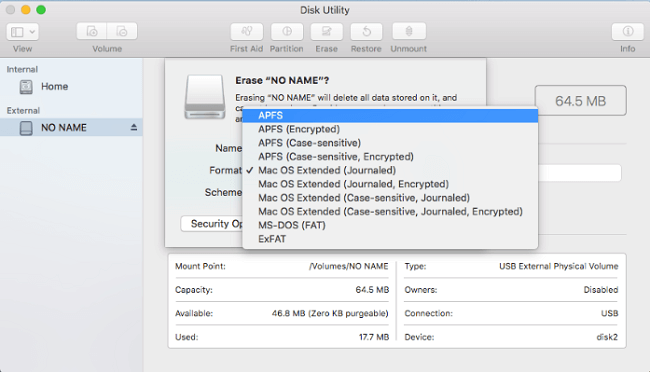
- You are now supposed to click on the Erase tab. Wait for the Volume format drop down list to appear.
- Go ahead and choose the format of your Hard Disk Drive. If you are using the Hard Disk only for Mac, then you must select Mac OS Extended (Journaled).
- Click on Erase, complete the formatting, and get set to read and write data on your Hard Disk Drive.
Part 3: How to Maintain External Hard Drive
Using and maintaining the hard drive are two different approaches. External hard drives are easy to use, but it becomes a peculiar task to maintain them. Typically, magnetic hard drives are supposed to be placed horizontally. Other than that, maintenance of their cable is also one of the few things that must be kept in mind. Here are few things that will be useful for you to use your external hard drive effectively:
- Figure out what you need to purchase: Choose a Hard Drive according to your requirements. There is no point in purchasing something that'll be of no use later. List out your requirements before making a purchase.
- Backing up the data: Your data isn't backed up until it is not stored in more than one location. A backup can easily be created by drag and drop option or with simple copy paste method. Another way is to use copy software that will copy the file to the directed destination after the setup has been completed. Use of automatic backup is also highly recommended.
- Hard Drive Security: Encrypting file information is a good option, but there are many smart hackers who can access your file. Make sure that you maintain the security of your hard drives with passwords and other security files that'll encrypt the important data on the hard drive.
It’s important for one to know how to use an external hard drive as proper maintenance and installation helps in sustainability of the Hard Disk. To begin with, one can consult their manuals or simply follow the instructions given above on how to use an external hard drive effectively.
Part 4: How to Recover Lost Files from External Hard Drive
If you lost data on your external hard drive unfortunately, don't worry! You still have the chance to get lost data back. To recover files from external hard drive, you can have a try the following tool.
Recoverit - Best External Hard Drive Recovery Software
- Recover lost or deleted files, photos, audio, music, emails from any storage device effectively, safely and completely.
- Supports data recovery from recycle bin, hard drive, memory card, flash drive, digital camera and camcorders.
- Supports to recover data for sudden deletion, formatting, lost partition, virus attack, system crash under different situations.
Video Tutorial on External Hard Drive Recovery
What's Wrong with Drive
- Recover Your Drive
- Fix Your Drive
- Format/Wipe Drive
- Know Your Drive