
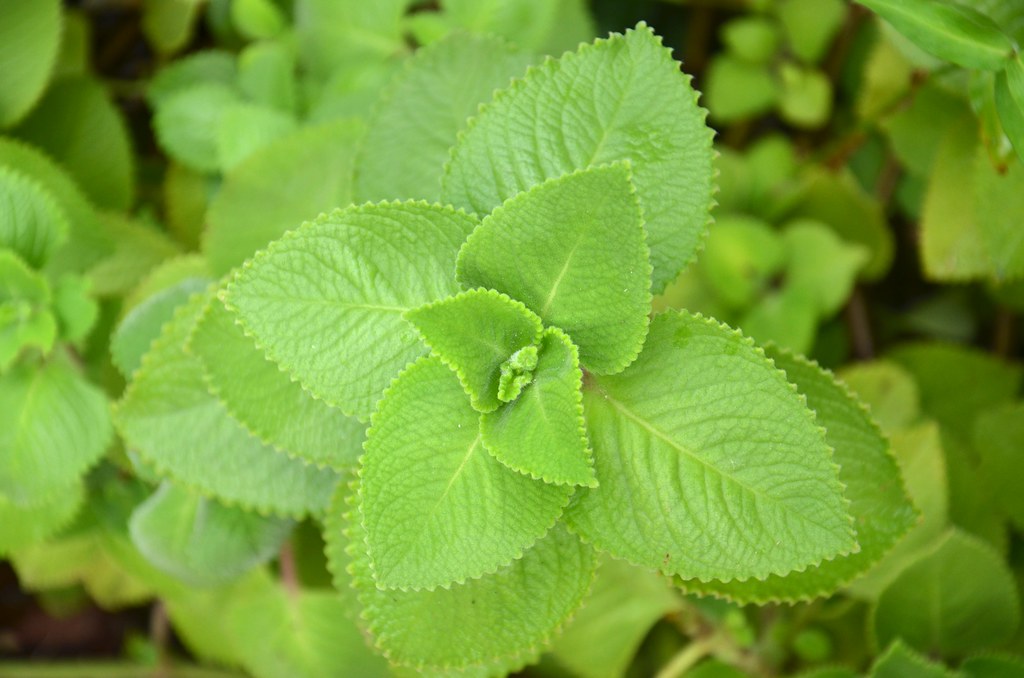
Panikoorka Uzhalakizhangu Bonda ( Indian Borage Potato Fried Dumplings) To give a twist to the regular aloo bondas (as it's known in the south) I added Indian borage leaves also known as French thyme a medicinal plant that is believed to cure cough and cold according to ayurveda.This plant is also fried as fritters with onions.
are there. Panikoorka is an Ayurvedic herb , the leaves are used for treating common cold, cough and fever in babies and adults. There are references in Ayurveda of the usage of this herb.The botanical name of Panikoorka is Plectranthus amboinicus . In India it is known as Indian borage, in Hindi known as Patta ajavayin, in Tamil – karpooravalli and referred as navaryila in Malayalam.
Panikoorka, natural remedy for fever, natural anti-pyretic
Panikoorka is very effective home remedy for cold, fever and cough in children. Leaves of panikoorka is squeezed and the juice is taken. A teaspoonful of Panikoorka juice when given to babies would cure their cough, cold, fever, sore throat, nasal congestion and chest congestion. Grownups should take 2 tablespoonful of juice to relieve fever.
Panikoorka, very effective for cough and chest congestion
Panikoorka is a
 natural expectorant for children. Boil the leaves of panikoorka for 5 mins in 1 cup of water. When cool feed 2 tspn of this decoction to children for curing their cough, and bronchitis. Adults can take quarter cup of Panikoorka decoction for getting relief from chronic cough and bronchial asthma. Panikoorka is most effective in children. It is an effective natural remedy for excess phlegm and chest congestion. Ideal for asthma patients, they can consume decoction regularly for relief.
Panikoorka helps improve lactation
Panikoorka helps improve lactation in nursing mothers. The health benefits will be transferred to the child through milk.
Panikoorka addresses First aid too
Applying the extract of panikoorka leaves on the area relieves itching, infection, wounds etc. It is also an effective antidote for insect bites and scorpion bite. It is also used in the treatment of skis, disorders, dandruff and different types of allergies.
Panikoorka can be consumed in different ways to minimize the bitter taste and strong odor.
The juice is extracted from leaves by placing them on a hot tava. The leaves will become transparent when hot. Remove from the tava and squeeze them with your fingers. In case of grown up you can directly squeeze the washed leaves with your fingers to collect juice.
Infants and Toddlers:
- Two three drops of panikoorka leaves juice would treat chest congestion, cough, and cold in infants. Two three drops of the juice when applied on head, would prevent cough and cold in children and adults.
- Panikoorka leaves extract can be mixed with honey and applied on mother's breast so that infant will suck it when they drink milk. You can also apply panikoorka leaves on child’s lips.
- Panikoorka leaves extract can be mixed with powdered organic rock sugar ( Kalkandam in malayalam ) and given to toddlers for throat infection, cough and cold.
- When children complain of stomach pains,problem of worm, you can give Panikoorka leaves extract mixed with sugar three times a day.
- For relieving cough take a mix of panikoorka leaves extract, honey and lemon juice two times a day.
- Inhaling vapors with panikoorka leaves extract would cure cold and fever.
- Add few leaves of Panikoorka into the boiling water for steam inhalation when you have cough and cold . If you are using vaporizer , dip a cotton ball into the Panikoorka juice extract and put it in the mouth of the vaporizer.
- People suffering with gas trouble and flatulence can have heated panikoorka leaves extract with honey twice daily. Grownups suffering from bronchial asthma can consume panikoorka leaves extract mixed with honey and kalkandam.
Panikoorkais a good substitute for oregana flavor in dishes. Can be used to flavor dishes of meat – beef , lamb, etc. Panikoorka is very commonly grown as a potted plant. Indian Borage is a fast growing plant. Propagation is via stem cuttings. The herb grows easily in a well-drained, semi-shaded position.
Try out this snacky recipe which will relieve throat pain and fever:
Panikoorka bajji
Ingredients:
- Panikoorka leaves 10 – 12 nos
- Chana powder -1 cup
- Onion finely chopped- ½ cup
- Green chillies finely chopped – 2 tsp
- Ginger finely chopped- ½ tsp
- Salt to taste
- Optional : addition of finely chopped curry leaves -1/2 tsp and Kothmir – 1 tsp
Mix all the ingredients. After 10 mins heat oil , dispense the mixture with a spoon into hot oil. Fry till it is brown. Drain bajjis onto tissue paper. Serve hot.
| Indian coleus | |
|---|---|
| Scientific classification | |
| Kingdom: | Plantae |
| Clade: | Tracheophytes |
| Clade: | Angiosperms |
| Clade: | Eudicots |
| Clade: | Asterids |
| Order: | Lamiales |
| Family: | Lamiaceae |
| Genus: | Plectranthus |
| Species: | |
| Binomial name | |
| Plectranthus barbatus | |
| Synonyms[1] | |
| |
Plectranthus barbatus, also known by the synonym Coleus forskohlii and vernacular names forskohlii[2] and Indian coleus, is a tropical perennial plant related to the typical coleus species. It produces forskolin, an extract useful for pharmaceutical preparations and research in cell biology.[3]
Name[edit]
The Brazilian name is boldo brasileiro (Portuguese pronunciation: [ˈbowdu bɾɐziˈlejɾu], or boldo gaúcho, as opposed to the Chilean true boldo), boldo-da-terra ([ˈbowdu dɐ ˈtɛʁɐ]), boldo-de-jardim ([ˈbowdu dʒi ʒaʁˈdʒĩ]) or tapete-de-Oxalá ([tɐˈpetʃi dʒ oʃaˈla]) (Oxalá's carpet, because of its velvety texture).
Chemistry[edit]
Herbal teas made from Plectranthus barbatus contains rosmarinic acid and also flavonoidglucuronides and diterpenoids.[4][5] The chemical constituents of Plectranthus barbatus showed activities in vitro, such as acetylcholinesterase inhibition.[3][4][5]
Forskolin, which derives its name from the former binomial name Coleus forskohlii, is a constituent of Plectranthus barbatus.[3][6]
Ayurveda[edit]
In Ayurvedictraditional medicine, Coleus has been used to treat heart diseases, spasmodic pain, painful urination and convulsions.[7]
Some of these new scenes contain links to the story of 'Valkyrie Profile 2: Silmeria'. To give players a deeper understanding of the plot and to complement the game's dramatic storyline, additional CG cutscenes have been incorporated. Valkyrie profile lenneth psp ita torrent free. Tri-Ace, the developers behind the acclaimed Star Ocean series and 'Radiata Stories', introduce new fans to the spectacular combo attacks, unique side-scrolling environment, and gripping storyline that first captivated players six years ago.
References[edit]
- ^'The Plant List: A Working List of All Plant Species'.
- ^'Plectranthus barbatus'. Natural Resources Conservation Service PLANTS Database. USDA. Retrieved 7 October 2015.
- ^ abcAlasbahi, R. H.; Melzig, M. F. (2010). 'Plectranthus barbatus: A review of phytochemistry, ethnobotanical uses and pharmacology - Part 1'. Planta Medica. 76 (7): 653–61. doi:10.1055/s-0029-1240898. PMID20178070.
- ^ abFalé, P.L., Borges, C., Madeira, P.J.A., Ascensão, L.; et al. (2009). 'Rosmarinic acid, scutellarein 4′-methyl ether 7-O-glucuronide and (16S)-coleon E are the main compounds responsible for the antiacetylcholinesterase and antioxidant activity in herbal tea of Plectranthus barbatus ('falso boldo')'. Food Chem. 114 (3): 798–805. doi:10.1016/j.foodchem.2008.10.015.CS1 maint: multiple names: authors list (link)
- ^ abPorfírio S, Falé PL, Madeira PJ, Florêncio MH, Ascensão L, Serralheiro ML (2010). 'Antiacetylcholinesterase and antioxidant activities of Plectranthus barbatus tea, after in vitro gastrointestinal metabolism'. Food Chem. 122: 179–187. doi:10.1016/j.foodchem.2010.02.044.
- ^Pizzorno, Joseph E.; Murray, Michael T. (2012). Textbook of Natural Medicine (4th ed.). Edinburgh: Churchill Livingstone. p. 686. ISBN9781437723335.
- ^Dubey MP, Srimal RC, Nityanand S, et al. (1981). 'Pharmacological studies on coleonol, a hypotensive diterpene from Coleus forskohlii'. J Ethnopharmacol. 3 (1): 1–13. doi:10.1016/0378-8741(81)90010-6. PMID7193263.
External links[edit]
- Photos and description of Plectranthus barbatus (www.ethno-botanik.org)